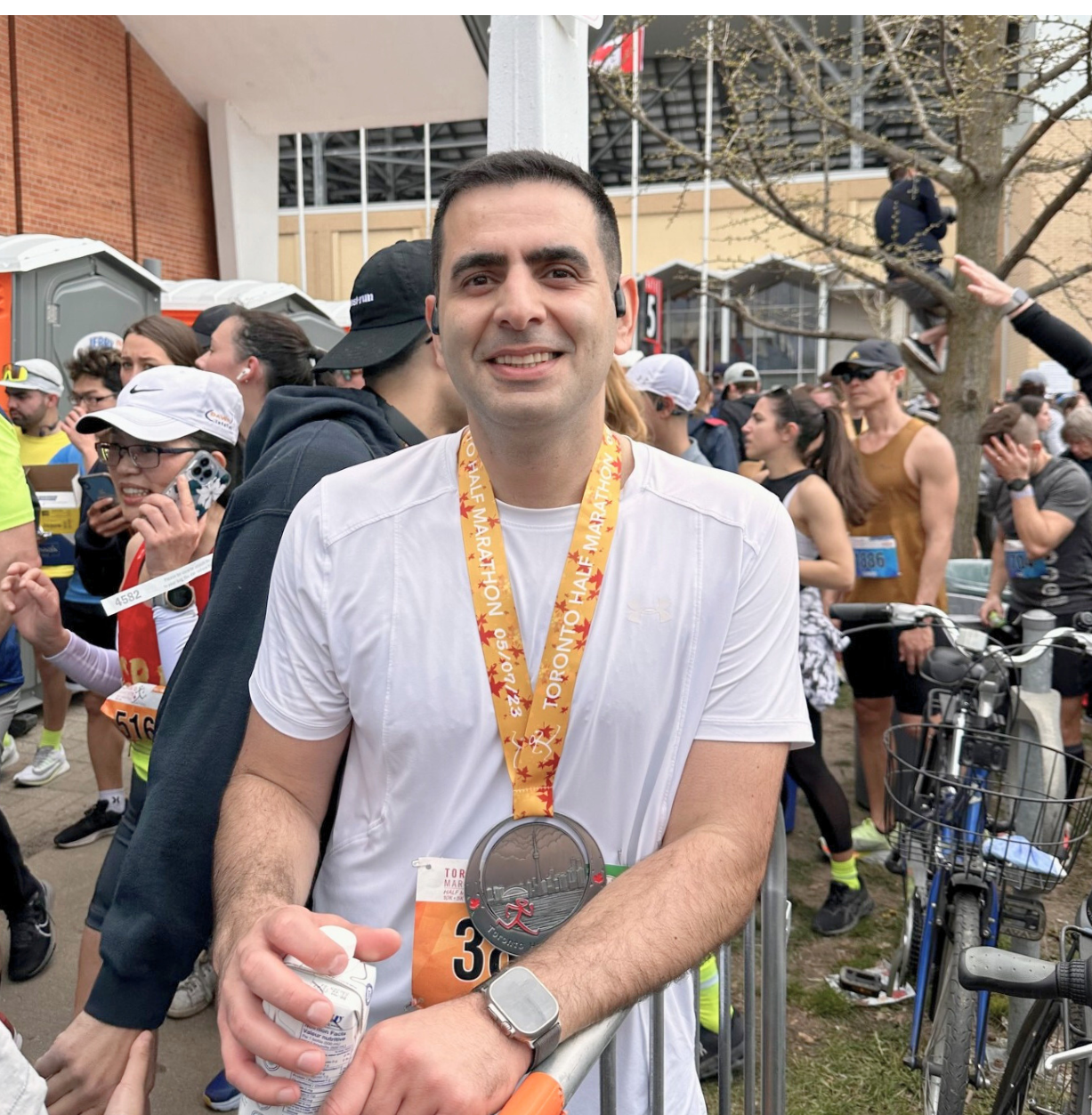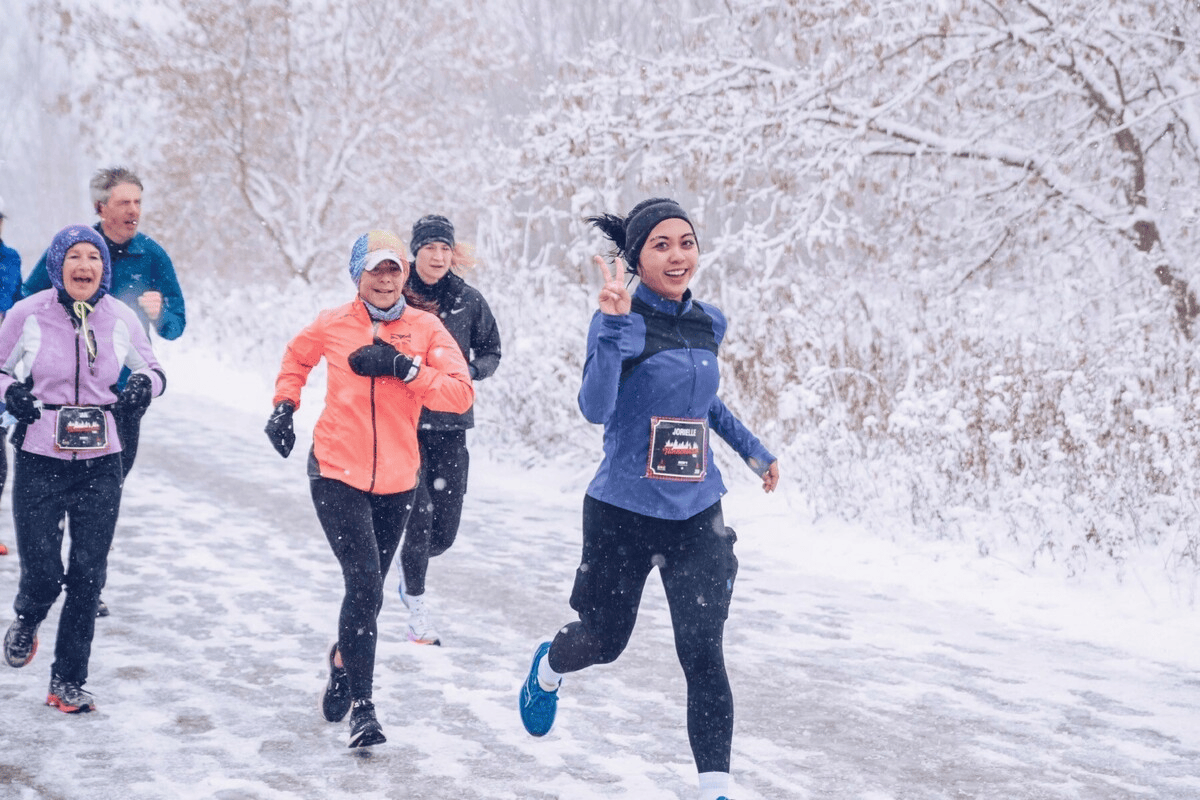
Training for a spring marathon in Toronto means one thing: you don't get to skip winter.
Ice. Snow. Wind that makes your face hurt. Daylight that disappears by 4:30pm. This is the part of marathon training most people don't talk about. Most training plans assume you live somewhere sensible — they weren't designed for Canadian winters.
But here's what I've realized: winter isn't just a challenge to survive. It's the foundation. If I can stay consistent from December through March, May becomes possible.
❄️ Training through winter alone is tough. Crewa matches you with running partners at your pace who actually show up — even when it's freezing.
Find Your Crew →I'm not an elite runner. I'm a regular guy in my 40s, coming back from a hip flexor injury, rebuilding fitness one ugly run at a time. I'm using the Nike Run Club 18-week marathon program, adapted for Toronto's reality.
This guide combines my personal training journey with expert advice from Toronto running stores like BlackToe Running and The Runners Shop, sports medicine research, and input from the Toronto running community. If you're training for a spring marathon like the Toronto Marathon, coming back from injury, or just trying to stay consistent through winter — this is for you.
"Winter running isn't about pace or performance. It's about showing up. That's it. That's the whole game."
Why Winter Training Actually Matters ❄️
Let's be honest: winter running can be miserable. But that's exactly why it works.
When it's cold and dark, you can't rely on motivation. Motivation is a summer thing — it shows up when the weather's nice and disappears the moment things get hard. Winter strips that away and forces you to build something better: discipline.
Here's what Toronto winter actually teaches you:
- Slowing down — Ice and snow force shorter strides and easier paces. This is exactly what base-building needs.
- Mental resilience — The biggest barrier is getting out there in the cold and freezing for the first 10 to 15 minutes while you warm up. If you can push through that, marathon day will feel easy.
- Stabilizer strength — Running on uneven, slippery surfaces builds muscles you didn't know you had.
- Consistency without ego — No one's setting PRs in February. You learn to run for the process, not the pace.
📚 Part of Our Toronto Running Series
This guide focuses on winter training and marathon prep. For a complete overview including routes, run clubs, and races, see our Ultimate Guide to Running in Toronto. For detailed route breakdowns, check 13 Best Running Routes in Toronto.
My goal for winter isn't speed — it's durability. I want to arrive at April with a body that's ready for the hard work, not one that's already broken down.
The 18-Week Marathon Plan (NRC + Toronto Reality) 🗓️
I'm following the Nike Run Club 18-week marathon training plan — but adapted for Toronto's winter. The app is free, Coach Bennett's voice is calming and motivating, and the structure is solid without being overwhelming.
For the Toronto Marathon on May 3, 2026, starting mid-January gives you the full 18 weeks. Here's how I've broken it into phases that work for our climate:
Phase 1: Rebuild the Habit
Focus: Consistency over distance. This is where most people quit. Every run counts, even the 20-minute treadmill ones.
Phase 2: Build the Base
Focus: Gradual long run growth. By now, winter has done its job — legs are stronger, patience is better, ego is gone.
Phase 3: Specific Marathon Training
Focus: Structured long runs, race pacing, mental prep. This is where winter's foundation pays off.
💡 Why Nike Run Club?
The NRC app is free, the guided runs are excellent, and Coach Bennett says exactly what you need to hear at kilometer 12. The 18-week plan is structured but flexible — you can swap days without feeling like everything is ruined.
Winter Routes That Actually Work 📍
Not all Toronto running routes are created equal in winter — some become death traps. Others are surprisingly reliable.
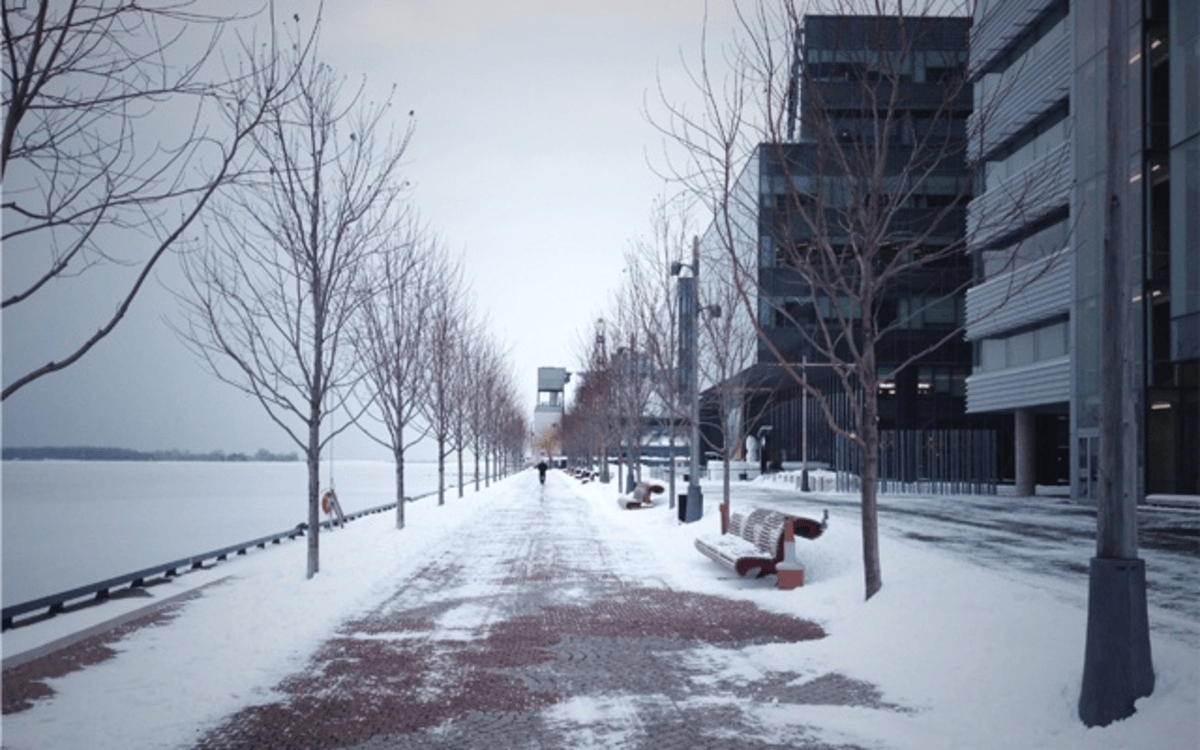
If you're in Toronto, head down to the waterfront and run along the Martin Goodman Trail. The MGT is sometimes salted and plowed ahead of the roads.
Martin Goodman Trail
Most ReliableToronto's #1 winter running route. Plowed and salted — sometimes even before the roads. Flat, predictable, and heavily travelled even when it's dark. Yes, it's windy — sometimes brutally so — but the maintenance is consistent.
❄️ Pro tip: Run into the wind on the way out — you'll have it at your back when you're sweaty and tired on the return.
High Park Main Roads
ReliableThe main roads through High Park get plowed. Rolling elevation makes it great for building strength — Spring Road Hill is a local favorite for repeats. Skip the side trails after snowfalls.
❄️ Pro tip: The area near Grenadier Pond is well-maintained and great for winter hill workouts.
Don Valley Trails
Use CautionBeautiful but inconsistent in winter. Best after a few dry, cold days when things have frozen solid. Great for summer shade, but risky in winter. Use cautiously and only in daylight.
❄️ Pro tip: Trail shoes with aggressive tread mandatory. Avoid for 48+ hours after any snowfall.
Neighborhood Sidewalks
Most ConvenientHonestly? This is where most of my winter miles happen. Sidewalks are often cleared faster than trails. Familiar, low mental load, easy bailout if conditions turn bad. No shame in loops around your block.
❄️ Pro tip: Map a 2-3km loop from your door. "Just one loop" is easier to commit to than a 10K plan.
Layering & What to Wear 👕
The golden rule of winter running gear: dress as if it's 10-20°C warmer than actual temperature. You'll warm up within 10 minutes, and overdressing leads to sweating, which makes you colder.
The Three-Layer System
Base Layer
Thin, snug, moisture-wicking fabric (merino wool or synthetic). Pulls sweat away from skin. AVOID COTTON — it holds moisture and makes you cold.
Mid-Layer
Insulating layer like a half-zip fleece or lightweight jacket. The half-zip is key — you can zip up or zip down depending on whether you are hot or cold.
Outer Shell
Wind and water resistant jacket. Being able to interchange the three layers gives you options depending on the temperature. Look for reflective elements for visibility.
Lower Body
Winter running tights with a warm inner layer. If your muscles are cold, they will not work correctly, so good winter running tights are necessary.
🧤 Extremities Are Critical
Head, hands, neck, and face lose heat fastest. Cover exposed skin to prevent frostbite in cold and windy conditions. Must-haves:
- Thermal gloves or mittens — Convertible mitts work as both
- Ear-covering hat or headband — Even when rest of you is warm
- Neck gaiter or buff — Can be pulled up as face mask
- Wool running socks — Wrightsock Merino and Feetures Cushion Merino are great choices
Temperature Guide: What to Wear When
🌡️ Dressing by Temperature
Local running stores like BlackToe Running and The Runners Shop can help you find gear that fits your budget and body.
Aim for about 6 oz of water every 15 minutes during longer runs, regardless of whether you feel thirsty.
Practical Winter Hydration Tips
- Drink before you go — 8-16 oz of water 30 minutes before your run
- Warm fluids work — If cold water is unappealing, warm water or herbal tea before running can help
- Insulated bottles — Regular bottles can freeze. Insulated ones keep water from turning to slush
- Keep bottles inside layers — Body heat keeps water liquid on shorter runs
- Rehydrate immediately after — Warm drinks post-run help warm you up AND rehydrate
☕ Post-Run Recovery
A warm drink after your winter run does double duty: rehydrates AND warms you up. Hot chocolate, tea, warm water with lemon, or even soup. Your body will thank you.
Winter Warm-Ups: Start Inside 🏠
In summer, you can get away with starting a run cold and warming up gradually. Winter is different. Cold muscles are injury-prone muscles.
The solution: warm up INSIDE before you go outside. Get blood flowing and muscles activated while you're still comfortable.
7-Step Indoor Warm-Up (5-8 minutes)
Light Movement (2 min)
March in place, gentle jumping jacks, or jog around your apartment. Get your heart rate slightly elevated.
Leg Swings - Forward/Back (30 sec each leg)
Hold a wall for balance. Swing one leg forward and back in a controlled motion. Opens up hip flexors and hamstrings.
Leg Swings - Side to Side (30 sec each leg)
Same position, swing leg across body and out to the side. Activates hip abductors and adductors.
Hip Circles (30 sec each direction)
Hands on hips, make big circles. Opens up the entire hip joint — critical for cold weather running.
Glute Activation: Bridges (10 reps)
Lie on your back, feet flat, push hips up. Hold at the top for 2 seconds. Wakes up your glutes.
Ankle Circles (30 sec each foot)
Important for stability on slippery surfaces. Circle both directions.
Walking Lunges (10 total)
Final activation before heading out. Gets legs ready for the work ahead.
🚪 First Kilometer Rule
Even after indoor warm-up, start your outdoor run VERY easy. First kilometer should feel almost too slow. No pace goals. Let your body finish adjusting to the cold before asking anything of it.
Winter Shoes & Traction 👟
Your summer road shoes work fine on dry, cold pavement. But snow and ice are different beasts.
Trail Running Shoes
Aggressive lugged outsoles grip snow and packed surfaces. BlackToe Running recommends having winter-specific shoes if you plan to run outdoors frequently.
Traction Devices
YakTrax, Microspikes, or Nanospikes slip over regular shoes and add metal coils or spikes for ice. Game-changer for icy conditions.
Waterproof Uppers
GORE-TEX or similar membranes keep snow and slush out. Also block wind, which helps keep feet warmer.
Wool Socks
Merino wool stays warm even when damp. Cotton socks + wet feet = cold, miserable run.
💡 Shoe Rotation Strategy
Many Toronto runners keep 2-3 pairs in rotation: regular trainers for dry cold days, trail shoes for snow, and traction devices for ice. Let wet shoes dry completely between runs — stuffing with newspaper speeds this up.
Indoor Training Days 🏋️
Let's kill the myth right now: treadmill running is real running. A training run on a treadmill counts just as much as one outside. It builds the same cardiovascular fitness and maintains your consistency.
Know your limit — If it's too icy, too cold or too windy, take it inside. Stay active and run another day.
When to Choose Indoor
- Wind chill below -20°C — Frostbite risk too high
- Ice everywhere — Risk of falls exceeds benefit of outdoor run
- Active storm conditions — Blizzards, freezing rain
- Early morning/late night darkness — If you don't have proper visibility gear
- You just don't want to — Mental health matters. An indoor run beats skipping entirely.
Treadmill Tips
- Set incline to 1% — Simulates outdoor resistance and wind
- Use guided runs — Nike Run Club treadmill runs make the time pass faster
- Vary the pace — Fartleks and intervals prevent treadmill boredom
- Entertainment helps — Music, podcasts, or TV shows
- Hydrate more — Indoor environments are often dry
🏃 Cross-Training Options
If treadmill isn't available or you need variety:
- Elliptical — Similar motion, lower impact
- Stationary bike — Maintains cardio, gives legs a break
- Swimming — Full-body workout, excellent for recovery days
- Strength training — Winter is perfect for building the strength base you'll need
Safety & Visibility 🔦
Toronto winter means limited daylight. Sunrise around 7:45am, sunset around 5pm in January. Most of us are running in darkness.
Run with lights. It's a small investment that could save your life.
Visibility Essentials
- Headlamp — So YOU can see the path ahead. Essential for spotting ice and obstacles.
- Clip-on blinkers — Front (white) and rear (red) so OTHERS can see you.
- Reflective gear — Jackets, vests, or bands with reflective strips.
- Light colors — If you don't have lights, at least don't wear all black. Yellow and orange are most visible.
Route Safety
- Stick to well-lit, well-travelled routes — Martin Goodman Trail near Harbourfront, High Park main roads
- Avoid unlit trails — Don Valley ravines are beautiful but dangerous in darkness
- Tell someone your route — Text a friend your plan and expected return time
- Carry your phone — In an accessible pocket, not buried in layers
- Consider running with others — See the Accountability Partners section
Accountability Partners: The Winter Secret Weapon 🤝
Here's the truth about winter training: motivation is unreliable, accountability isn't.
When it's -10°C and dark and your bed is warm, motivation evaporates. But if someone is waiting for you at the corner at 6:30am? You show up. That's the difference between people who maintain fitness through winter and people who start over every spring.
"Motivation gets you started. Accountability keeps you going when it's cold, dark, and you'd rather be anywhere else."
Finding Winter Running Partners
- Run clubs — Toronto has 50+ running clubs, though many reduce winter schedules. BlackToe Running hosts runs on Fridays (tempo) and Sundays (long runs 12-24K) year-round.
- Crewa — Our app matches you with 2-4 verified runners in your neighborhood at your pace. Perfect for winter because it's a smaller, committed crew rather than a big group that might cancel.
- Friends and colleagues — Recruit someone training for the same goal.
- Virtual accountability — Strava groups, NRC challenges, or even a text thread with other runners.
Find Your Winter Running Crew
Crewa matches you with 2-4 verified runners in Toronto — matched by your pace, schedule, and neighborhood. Because showing up is easier when someone's counting on you.
Find Running Partners →The Toronto running community is surprisingly active in winter. parkrun at Downsview Park runs every Saturday at 9am, rain or shine or snow.
Frequently Asked Questions ❓
Can you really train for a marathon during Toronto's winter?
Yes — and winter is actually ideal for spring marathons. The cold forces you to slow down and build base properly. Start an 18-week plan mid-January for the Toronto Marathon in May.
What's the most reliable winter running route?
The Martin Goodman Trail along the waterfront. It's plowed and salted regularly — sometimes even before the roads.
How cold is too cold to run outside?
Most runners stay safe down to -15°C to -20°C with proper gear. Below -20°C wind chill, consider indoor alternatives.
What should I wear for -10°C running?
All three layers: moisture-wicking base, insulating mid-layer half-zip, and wind-resistant shell. Thermal tights. Mittens, warm hat, neck gaiter for face coverage if windy.
Do I need special winter running shoes?
On dry, cold pavement, regular trainers work fine. For snow and ice, consider trail shoes with aggressive lugs or add YakTrax/Microspikes for traction.
Does treadmill running count for marathon training?
Absolutely. A treadmill run builds the same cardiovascular fitness as outdoor running. Set incline to 1% to simulate outdoor conditions.
Do I need to drink water in cold weather?
Yes — cold suppresses thirst by up to 40%, but you're still losing fluids. Aim for 6 oz every 15 minutes on longer runs.
Where can I find winter running partners in Toronto?
BlackToe Running hosts year-round runs. parkrun continues every Saturday. Toronto has 50+ run clubs. For personalized matching, Crewa connects you with 2-4 runners at your pace.
Follow the Journey
Training for a marathon isn't just about the miles — it's the daily grind. Follow along as I document the ugly, honest truth of winter training in Toronto.
📷 Follow @hoomanhashemiiReal runs. Real weather. Real talk.